
How to Find Your Dress Size Without Guessing at It
Your dress size is not a fact about you, it is a lookup in one brand's chart. Here is the measurement that governs it and how to run the lookup properly.
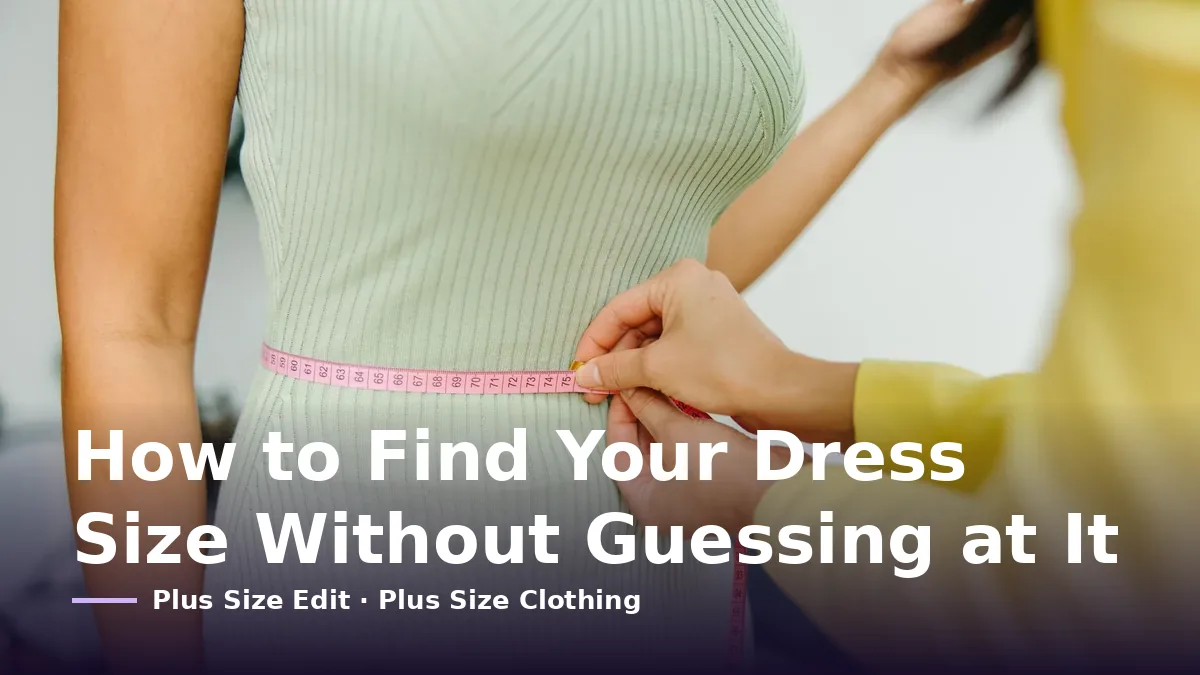
There is no answer to “what dress size am I.” There is only “what size am I at this brand, in this garment,” and the good news is that this question has a real answer you can look up in about two minutes.
The step everyone skips is the first one: knowing which of your measurements the number is actually built on.
Bust is the measurement that governs
For dresses, the number is a bust number. EN 13402, the European standard for size labelling, names the primary dimension for each garment type, and for dresses, knits and blouses it is bust girth. Waist girth leads for trousers, shorts and skirts; bras use underbust plus bust.
The traditional numbering says the same thing in arithmetic. Both the US and UK dress scales were defined from bust circumference in inches:
- US size
= bust − 28 - UK size
= bust − 24
A 40-inch bust is a US 12 and a UK 16. A 44-inch bust is a US 16 and a UK 20.
Treat those as a sanity check, not an answer. They tell you what the scale was built on, which is genuinely useful when a chart looks wrong. They do not tell you what any brand cut this season, and they run out of road above the straight-size range.
Take the three measurements
You need bust, waist and hip, in that order of importance for a dress.
Bust. Around the fullest point, tape level all the way round — check the back in a mirror, because a tape that rides up behind reads small. Wear the bra you would actually wear with the dress. A different bra gives a different bust reading, which is why the lookup has to be done with the bra you will have on.
Waist. Around your natural waist, the narrowest point. For a dress this is the true waist, not the lower line you wear jeans at — but if you are going to compare against trouser charts too, take that one as well. Duluth Trading’s instruction is the one to copy for fit allowance: “Insert your forefinger between the tape and your body to allow ease in fit.”
Hip. Around the fullest point, standing with your feet together. Feet apart widens the reading.
Breathe normally. Do not hold the tape tight — you are measuring a body, and the garment’s own ease is the brand’s job, not something to subtract by hand.
Run the lookup
- Open the size chart on the product page. Every time. Not a chart you saved, not the size you wore at another brand.
- Find the row your bust falls in. That is your candidate size for a dress.
- Check waist and hip against the same row. If all three land in or near it, you are done.
- If they disagree, take the largest. Something too small cannot be let out. Structured dresses — anything boned, fitted through the bodice, or cut without stretch — are the least forgiving, so this rule is firmest exactly where it matters most.
- Note which measurement forced the size up. That is the alteration you will be making, and it is worth knowing before you buy rather than after.
Why three sizes is normal
A chart is drawn from one set of proportions. Your bust, waist and hip pointing at three different rows means only that your proportions differ from the model the brand drafted around, which is true of nearly everyone.
There is a structural version of this too. US sizing is not a single scale: ASTM D5585 covers the Misses figure type in sizes 00–20, and ASTM D6960 covers the Plus figure type in 14W–40W. Two tables, two figure types, and their labels overlap from 14 to 20 — the numbers repeat, which is not the same as the bodies matching. Near that boundary a brand may genuinely fit you differently in an 18 and an 18W, and neither is the “right” one. We are working from the titles here: both standards are paywalled, so we cannot tell you what is inside them.
What not to do
- Do not convert from a size you wore elsewhere. There is no mandatory clothing size or labelling standard in the US; the voluntary guide “was abolished altogether in 1983.” Two size 10 dresses from different companies “may have grossly different dimensions.”
- Do not trust a letter. Universal Standard publishes L as 22–24. The Lands’ End women’s chart publishes L as 14–16. Both are correct for their own ranges and neither can be converted to the other.
- Do not measure over a coat, or with a tape you have pulled snug. Both make the number smaller than the body, which is the direction that leads to a dress you cannot do up.
Related reading
The full picture of why charts disagree — the two ASTM tables, and what happens when a retailer prints Misses and W sizes in one table — is in our clothing size chart women guide. If the dress is listed in British sizes, the uk size 6 to us table handles the label conversion. For everything else you measure, start at size guides.
Sources
- EN 13402 — Wikipedia — bust girth as the primary dimension for dresses, knits and blouses
- Clothing sizes — Wikipedia — the bust-based size formulas, absence of a mandatory US standard, the 1983 abolition, differing dimensions between brands
- ASTM D5585-21 and ASTM D6960/D6960M-16(2023) — the Misses and Plus size ranges (titles only; the standards are paywalled)
- Universal Standard size finder and Lands’ End women’s trousers size chart — the two conflicting letter mappings
- Duluth Trading size guide — the tape-ease instruction
Frequently asked questions
Which measurement decides a dress size?
Bust, in almost every case. EN 13402 names bust girth as the primary dimension for dresses, knits and blouses, and the traditional size formulas are defined from bust circumference in inches. Waist and hip still have to fit, but bust is what the number is built on.
Is there a formula for dress size?
The historical ones are US size equals bust in inches minus 28, and UK size equals bust minus 24. They tell you where the scale came from rather than what a brand cut this season, so use them to sanity-check a chart, not to replace it.
What if my bust, waist and hip point at three different sizes?
That is normal and it is not a problem with your body. Take the largest of the three for anything structured, because a garment that is too small somewhere cannot be let out, while a loose waist can usually be taken in.
- #dress size
- #measuring
- #size charts