
Sturdy Queen Bed Frames: Why Queen Is the Threshold
In the three mattress warranties we read, queen is where each one starts writing a separate clause for your size. What changes is the leg count, not the rail.
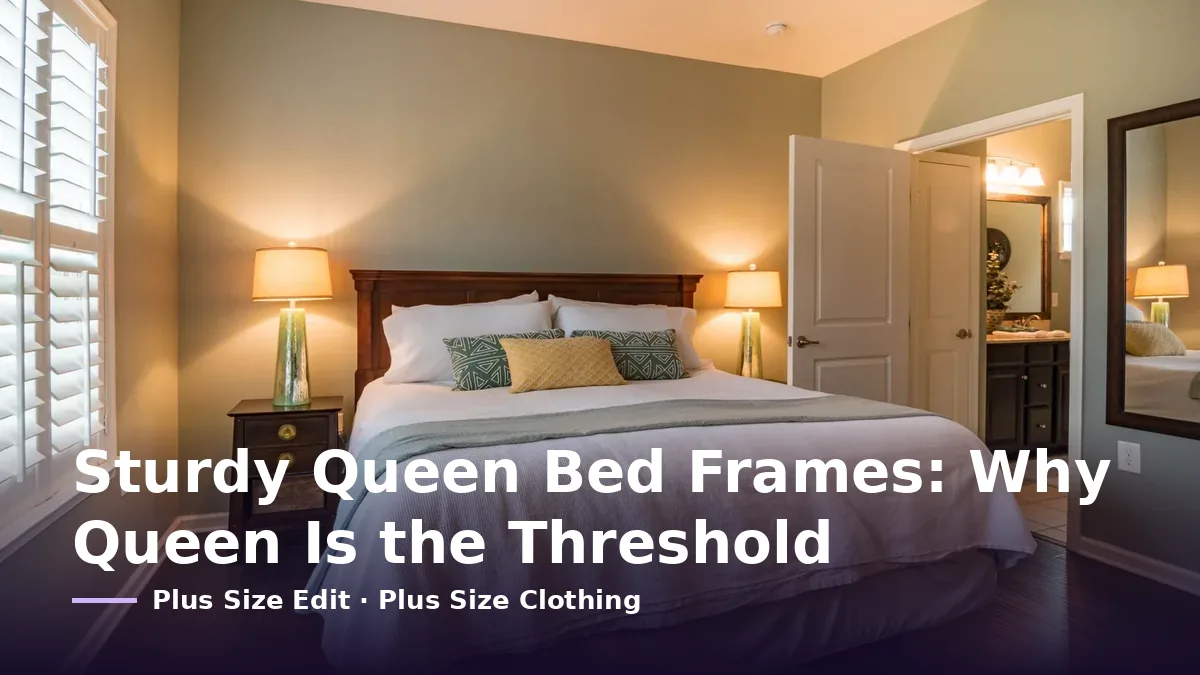
Queen is the size at which the paperwork starts talking about you specifically. In the three mattress warranties we read, each one writes a clause that begins at queen — and works differently below it.
That is not a marketing tier. It is a span problem, and the documents are unusually concrete about it.
The number that changes
US mattress sizes are published consistently. Purple lists them as Twin “38-by-75 inches”, Full “54-by-75 inches”, Queen “60-by-80 inches”, King “76-by-80 inches”.
So going twin to queen adds 22 inches across the bed. Whatever crosses that width is carrying the middle of the mattress, and the middle of that width is what the frame has to span. A frame comfortably rigid at 38 inches is doing substantially more work at 60.
What actually changes at queen: the leg count
Here is the correction worth making early, because the summary that suggests itself is the wrong one.
A center support is not a queen-and-above concern in two of these three documents. It is required outright:
Purple: a proper bed frame must “include a center support, and have at least 5-6 legs for Queen, King and Cal King, and 4 legs for Twin and Full mattresses.”
Beautyrest: “If used with a foundation, use a frame that provides rigid center support as well as support for the head, foot, and sides.”
Neither sentence carries a size condition. Purple’s size clause governs legs, not the rail. Beautyrest’s governs when a foundation is in use, not what size the bed is.
One of the three does tie the rail itself to size:
Saatva: “Queen and larger size frames must have vertical center support”, and, for a standard frame, “the warranty shall be void if the foundation is not supported by a 5- or 6-legged bed frame on queen or larger sizes.”
And Saatva’s terms relax below that line: “If you have a full or twin size bed, your warranty will be valid with the use of a 4-legged metal frame.”
So if you own a full or a twin and have taken “center support is a queen thing” on trust, two of these three documents disagree with you. The thing that genuinely steps up at queen, in the documents that mention it, is how many legs reach the floor — four below, five or six at queen and above.
Beautyrest adds a third kind of queen clause: “For any queen or king frame that does not have a metal center support, you must use at least 5 hardwood or metal slats (1" x 4") and add legs to the 3 center slats.” That is a fallback specification, and it is the most useful sentence in any of the three because you can count it.
“Vertical” is the load-bearing word
Saatva’s phrase is vertical center support, and Purple’s requirement is a leg count rather than a rail count. Both point at the same distinction, which is easy to miss in a product photo.
A center rail that runs the length of the bed and bolts to the head and foot boards ties the frame together and resists racking. What it does not do, on its own, is move weight from the middle of the mattress to the floor — it hands that weight back to the same two end panels.
Legs under the center rail change what the rail is for. The middle of the bed gets its own path to the ground, and the span that mattered at 60 inches is effectively halved.
That is why leg count appears in these documents instead of a capacity figure. Five or six legs on a queen means four corners plus one or two under the center rail. It is a proxy, and unlike a stated load rating it is something you can verify by looking.
What to ask before you order
A listing for a heavy duty bed frame will often lead with a capacity number. For a queen, these four questions get you further:
- Does the center rail have legs that reach the floor, and how many? Not “is there a center rail.”
- How far apart are the slats? Then check that gap against your own mattress’s warranty rather than a general rule — the three we read permit anywhere from 2 to 4 inches, so there is no single right answer to quote.
- What are the slats made of and how wide are they? Beautyrest’s fallback specification is 1 inch by 4 inch hardwood or metal, useful precisely because it is written down somewhere.
- Is the center support metal? Beautyrest’s fallback only applies “for any queen or king frame that does not have a metal center support” — so the answer changes which rule governs you.
Asking in writing is worth the extra minute. A seller who can answer all four is quoting from a specification sheet rather than a category name, which is the same signal we looked for when reading the spec sheet on an office chair for a heavy person.
“Sturdy” is not a specification
Worth saying plainly, because it is the word in the search box. None of the pages we read attaches a standard, a test or a published threshold to the word sturdy. It is doing the job “wide” does on chair listings and “oversized” does on towels — signalling a category rather than stating a measurement.
The four questions above are an attempt to convert that word into things with numbers: legs, gaps, material, dimensions. None of them promises how a frame will feel or how long it will last. They are the specifications your mattress’s own paperwork is written in terms of, which makes them the ones a dispute would turn on.
Where this stops
We have not tested bed frames, and we are not saying a frame with fewer legs will fail — plenty of furniture outlives the paperwork that governs it. Three warranties are three warranties: we picked them, they are not a sample, and we are not claiming anything about brands we did not read. If one of these three is the mattress you own, the wording above is the wording that applies to you.
The parallel on the seating side is exact. A capacity figure on a heavy duty office chair is also a number without a named test behind it unless the listing says which one. Furniture is sold on round numbers; the specifications that decide disputes are somewhere else, and they are free to read.
Frequently asked questions
Do bed frame requirements change at queen size?
In the three mattress warranties we read, each one writes a separate clause that begins at queen. What that clause changes is mostly the leg count: Purple asks for 'at least 5-6 legs for Queen, King and Cal King, and 4 legs for Twin and Full mattresses', and Saatva, for a mattress on a standard frame, voids coverage where a queen or larger foundation is not on 'a 5- or 6-legged bed frame'. That is three named documents, not an industry rule.
Is a center support only needed at queen size and above?
Not in two of the three warranties we read. Purple's requirement that a proper frame 'include a center support' carries no size condition at all, and Beautyrest asks for a frame providing 'rigid center support' wherever a foundation is used. Only Saatva ties the center support itself to size, stating that 'Queen and larger size frames must have vertical center support.' So on two of these three mattresses, a full or twin frame needs one too.
What can I count in a product photo to check a queen frame?
Beautyrest's warranty gives the one specification that is countable rather than descriptive: for a queen or king frame that does not have a metal center support, 'you must use at least 5 hardwood or metal slats (1" x 4") and add legs to the 3 center slats.' Five slats of a stated dimension, with legs under the middle three, is something a clear photograph can show.
- #bed frames
- #queen
- #center support