
Extra Wide Shower Curtains: Sizing a Curtain Correctly
A curtain maker publishes four size classes, and extra wide is 108 by 72 inches. What it does not publish is how much wider than your rod the curtain should be.
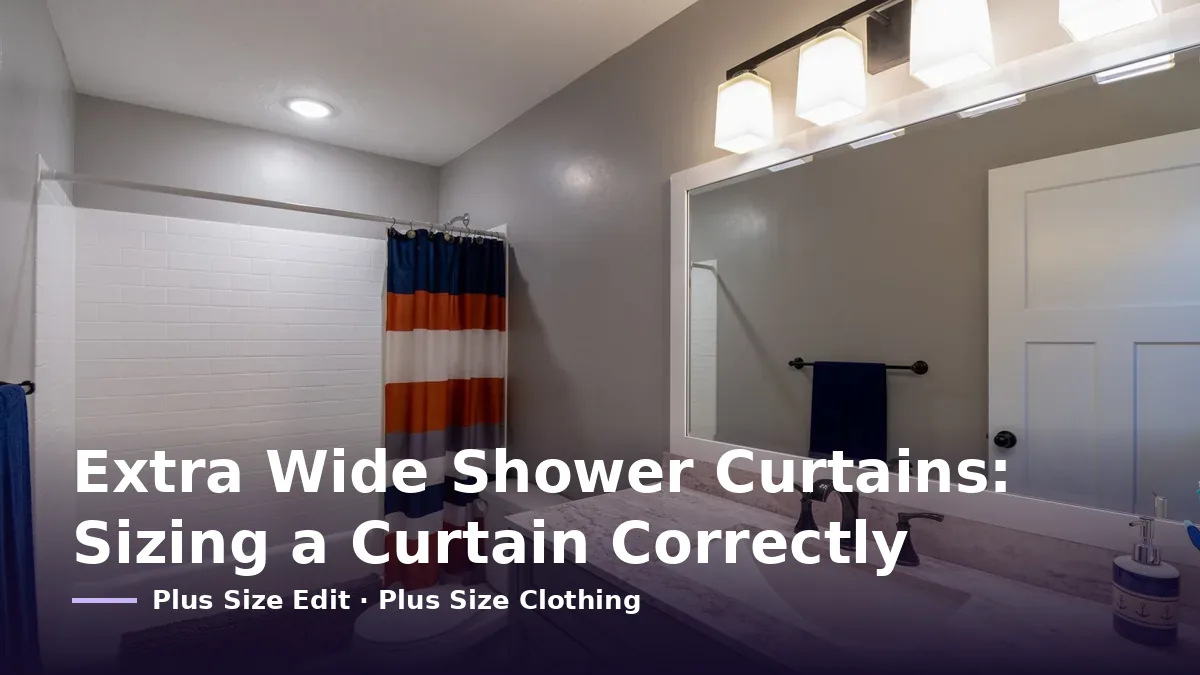
Shower curtains are sold by adjective — standard, stall, extra-long, extra-wide — and the adjectives do have numbers behind them, at least on the manufacturers’ own charts. What is missing is the one rule you would actually need to pick between them.
Here is what is published, and here is the gap.
The four size classes, as one manufacturer publishes them
The curtain manufacturer Bean Products lists these on its own size chart:
| Class | Published size |
|---|---|
| Standard Tub | 72 x 72 |
| Extra-Long | 72 x 84 |
| Extra-Wide | 108 x 72 |
| Stall Size | 54 x 72 |
On a second page, the same manufacturer writes: “The most common size is 72 x 72 inches. This size fits most tubs and gives full splash protection.”
Two things fall straight out of that table, both just arithmetic on published numbers.
First, the standard is square — 72 by 72. That is unusual enough among home textiles to be worth noticing, and it means the two adjectives have somewhere obvious to go.
Second, they go in opposite directions. Extra-Long adds 12 inches of drop and leaves the width alone. Extra-Wide adds 36 inches of width and leaves the drop alone. A high ceiling and a wide opening are different problems, and buying the wrong adjective does not half-solve the other one. If your opening is both, that chart has a fifth row — Custom — and no stock answer.
The rule that is not published
Now the part that sent us looking in the first place. If your rod measures, say, 66 inches wall to wall, how wide does the curtain need to be?
We could not find that stated on either manufacturer page we were able to read, and so we are not going to give you a number. It would be easy to; there are ratios in circulation. But a figure we cannot trace to a source we actually read is not something we are going to publish, and softening it into “a bit wider than the rod” would be the same unsourced number wearing a hat.
What those pages do give you is a procedure, quoted here in their words:
- “Measure the width from wall to wall”
- “Measure the rod height from the floor”
- “Keep the curtain slightly above the floor”
- “Make sure the curtain can move freely”
- “Leave space for hooks or rings”
That last pair is the closest either page comes to the question: they are the only thing on them about needing room past the flat measurement, and neither attaches a quantity to it. How much past that you go is a judgement about your own bathroom, and we would rather tell you that plainly than invent a ratio to fill the space.
One thing the numbers can settle
We cannot give you the rule for how much wider than the rod to go. We can give you the other half of it, which is a hard limit rather than a judgement.
A standard curtain in that chart is 72 inches wide, flat. If the run you need to cover measures more than 72 inches wall to wall, the standard class is out on arithmetic alone — not “probably too tight,” but unable to reach across even pulled flat with no gather at all. The same logic puts the stall size at 54 inches and the extra-wide at 108.
That is a necessary condition, and it is worth separating from the sufficient one. Your measurement rules classes out; it does not, by itself, tell you which of the remaining classes hangs well, because fullness depends on how much fabric you want gathered and nobody we read publishes a figure for that. Knowing which half of the question you have answered is most of the value of measuring.
What to do with your tape measure
- Measure wall to wall, not the curtain you already own. An existing curtain tells you what somebody bought once, which may be the reason you are here.
- Measure the rod height from the floor, then decide your drop. The published classes give you 72 or 84 inches; if neither lands, that is what the Custom row exists for.
- Check what the rod is fixed to. A curved or offset rod changes the distance the fabric has to travel, and the chart’s flat numbers say nothing about it.
- Then read the product’s own dimensions — not its adjective. “Extra wide” told us 108 x 72 on one manufacturer’s chart and is not obliged to mean the same thing on anyone else’s.
Where our evidence stops
We read two pages from one curtain manufacturer. That is the basis for every figure above, and it is a narrow one — one company’s size classes, published by that company.
We also tried to check dimensions on two large home-improvement retailers and their product pages returned errors to us, so nothing from them appears here. If you want a second published opinion on what a size class means, the place to get it is the specification table of the specific curtain you are considering, which is free to read and is the number that will actually arrive.
The adjective problem is not confined to bathrooms
None of this is special to curtains. “Extra wide” is doing the same work here that “wide” does on furniture listings, where we found that the word only becomes checkable once a published measurement is attached to it — see our guide to the wide office chair. It is the same shape as the towel aisle, where the standard bath towel size turns out to be four different numbers depending on whose page you are reading, and where a product labelled a bath sheet can be shorter than one labelled an oversized bath towel.
The habit that survives all three is the same: find the number, and if there is no number, that is the finding.
Frequently asked questions
What size is an extra wide shower curtain?
On the size chart published by the curtain manufacturer Bean Products, Extra-Wide is listed as 108 x 72 inches, against 72 x 72 for a standard tub. That is one manufacturer's size class rather than an industry definition — we found no published standard behind the term on the pages we read, so the figure worth trusting is whichever one appears on the product you are actually buying.
How much wider than my shower rod should the curtain be?
We could not find that rule stated on either of the manufacturer pages we were able to read, so we are not going to put a number on it. What those pages do tell you to do is measure: 'Measure the width from wall to wall' and 'Make sure the curtain can move freely.' The margin you want past that measurement is a judgement, and nobody we read publishes a figure for it.
What is the difference between extra wide and extra long?
They change different dimensions. On the size chart published by the curtain manufacturer Bean Products, a standard tub curtain is 72 x 72 inches, Extra-Long is 72 x 84 and Extra-Wide is 108 x 72. So extra-long adds 12 inches of drop while extra-wide adds 36 inches across and leaves the drop alone. A tall shower and a wide one are two separate problems with two separate products.
- #shower curtains
- #sizes
- #measuring